The Finger Multiplication Trick: Multiply 6 to 9 Using Only Your Hands
What if your child could multiply 7 x 8 in seconds — without memorising a single fact? No flashcards, no drills, just two hands and a trick that merchants and scholars have relied on for over a thousand years.
It is called finger multiplication, and it turns the hardest part of the times tables — the 6s, 7s, 8s, and 9s — into something you can literally count on your fingers.
Why the Upper Times Tables Are So Hard
Most children pick up the 1-5 times tables fairly quickly. But once they reach 6 x 6 and above, the numbers feel bigger, the patterns less obvious, and the memorisation load doubles. Research consistently shows that multiplication facts involving 6, 7, 8, and 9 are the last to be learned and the first to be forgotten.
That is exactly the range where finger multiplication shines.
How the Finger Multiplication Trick Works
Here is the core idea: you only need to know your times tables up to 5 x 5. Your fingers handle the rest.
Setting Up Your Hands
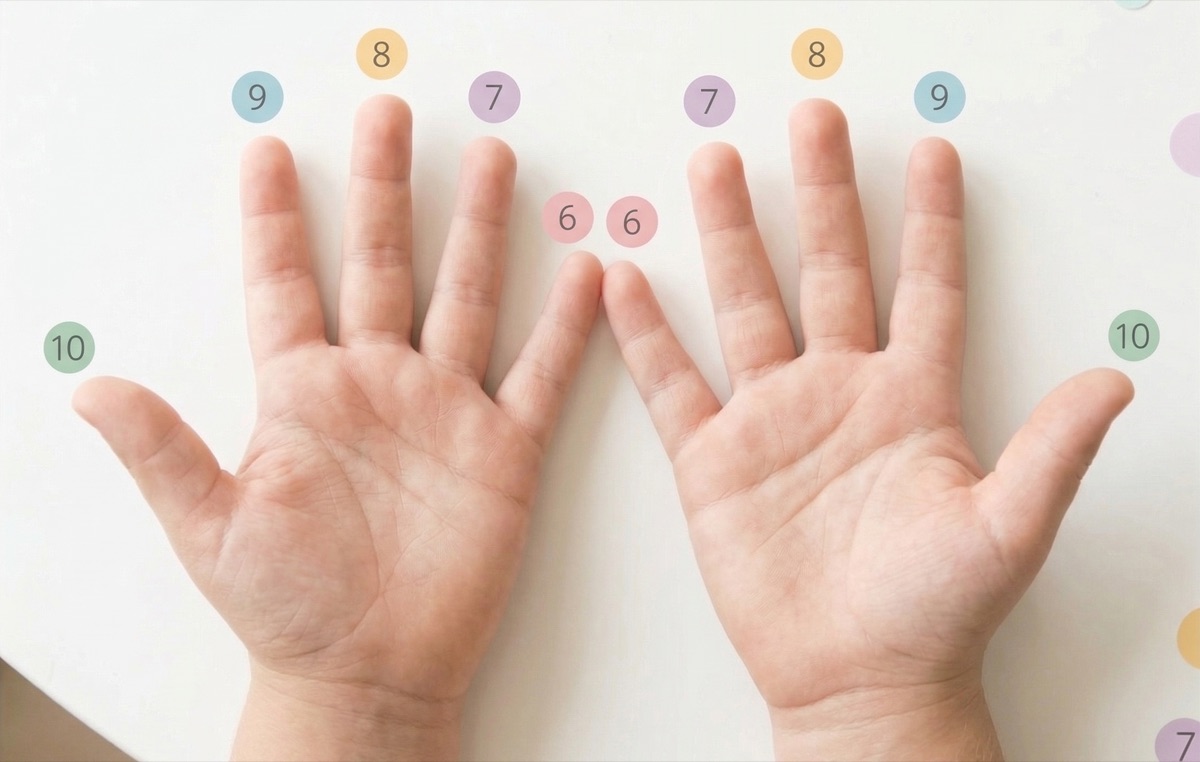
Hold both hands in front of you, palms facing you, fingers pointing upward. Assign a number to each finger on both hands:
- Pinky = 6
- Ring finger = 7
- Middle finger = 8
- Index finger = 9
Both hands use the same assignment. The thumbs are not assigned a number, but they still count when tallying remaining fingers later. You now have a calculator built into your body.
The Three-Step Process
Let's say you want to multiply 7 x 8.
Step 1 — Touch the matching fingers together. On your left hand, lower your ring finger (7). On your right hand, lower your middle finger (8). Touch those two fingers together.
Step 2 — Count the tens. Count the two touching fingers plus every finger below them. These are your tens.
- Left hand: pinky (6) + ring finger (7) = 2 fingers
- Right hand: pinky (6) + ring finger (7) + middle finger (8) = 3 fingers
- Total: 2 + 3 = 5 fingers = 50
Step 3 — Multiply the remaining fingers. Count the fingers above the touching point on each hand and multiply them together.
- Left hand: middle, index, thumb = 3 fingers
- Right hand: index, thumb = 2 fingers
- 3 x 2 = 6
Final answer: 50 + 6 = 56. And 7 x 8 is indeed 56.
Another Example: 6 x 7
Touch your left pinky (6) to your right ring finger (7).
Tens: The touching fingers and those below: left pinky + right pinky + right ring finger = 3 fingers = 30.
Remaining fingers above:
- Left hand: ring, middle, index, thumb = 4
- Right hand: middle, index, thumb = 3
- 4 x 3 = 12
Final answer: 30 + 12 = 42. Correct.
One More: 9 x 8
Touch your left index finger (9) to your right middle finger (8).
Tens: Left hand has pinky, ring, middle, and index = 4. Right hand has pinky, ring, and middle = 3. Total = 7 fingers = 70.
Remaining fingers above (including thumbs):
- Left hand: thumb = 1
- Right hand: index, thumb = 2
- 1 x 2 = 2
Final answer: 70 + 2 = 72. Spot on.
Why Does This Actually Work?
This is not a party trick — there is real maths behind it. Here is the algebra.
When you multiply two numbers a and b (each between 6 and 9), you can write them as:
- a = 5 + (fingers below on the left hand)
- b = 5 + (fingers below on the right hand)
The number of fingers below the touching point on each hand is (a - 5) and (b - 5). The number of fingers above is (10 - a) and (10 - b).
The trick calculates:
10 x [(a - 5) + (b - 5)] + (10 - a) x (10 - b)
Expanding this:
= 10a - 50 + 10b - 50 + 100 - 10a - 10b + ab
= ab
The algebra collapses perfectly to give you a x b. Every single time.
A Trick with Ancient Roots
Finger arithmetic is far older than you might expect. The earliest detailed written account comes from the Venerable Bede, an English monk who described an elaborate finger-counting system in his 725 AD treatise De temporum ratione ("On the Reckoning of Time"). Bede's first chapter, De computo vel loquela digitorum ("On Computing and Speaking with the Fingers"), catalogued over fifty finger symbols capable of representing numbers up to one million.
But Bede was documenting a tradition, not inventing one. Classical authors like Herodotus referenced finger reckoning centuries earlier, and the practice was widespread across the Roman Empire, the Middle East, and Asia. In an age before cheap paper and widespread literacy, your hands were the most reliable calculator you carried.
The finger multiplication trick specifically — the version for 6 to 9 — appears in medieval European arithmetic texts and was used by merchants and traders who needed to compute quickly without writing materials. The Italian mathematician Luca Pacioli included finger computation in his landmark 1494 work Summa de Arithmetica, the same book that established double-entry bookkeeping.
The technique survived because it works, it is portable, and it requires zero equipment. Over a thousand years later, it is still being taught in classrooms around the world.
Tips for Teaching This to Children
-
Start with one example. Pick 7 x 8 — it is the most commonly forgotten times table fact. Let them experience the "magic" before explaining the method.
-
Label the fingers. Write the numbers 6-9 on their fingertips (pinky to index) with a washable marker. This removes one layer of abstraction while they are learning.
-
Practise the tens count first. The trickiest part is consistently counting the touching fingers and those below. Have them practise just this step before adding the multiplication of remaining fingers.
-
Let them verify. Encourage children to check their finger answer against a calculator. Building trust in the method is half the battle.
-
Connect it to the algebra later. Once they are comfortable with the trick, showing them why it works is a wonderful "aha" moment that builds mathematical confidence.
Try It Yourself
Hold up your hands right now and try 8 x 8. Touch your two middle fingers together. Count the tens (6 fingers = 60). Multiply the remaining fingers above (2 x 2 = 4). The answer is 64.
Now you have got a thousand-year-old calculator at your fingertips — quite literally.
If you want to put your times tables to the test against other players in real time, give MiaMaths a go. It is a free multiplayer game where the first player to answer 10 multiplication questions correctly wins. Finger trick allowed.
Frequently Asked Questions
Does finger multiplication work for numbers below 6?
The standard technique covers 6 through 9, which is exactly the range most people find hardest. For 1-5, the times tables are typically straightforward enough to memorise directly, and multiplying by 10 is trivial. Variations of finger multiplication do exist for other ranges (such as 11-15), but they use a slightly different method.
What happens when the "remaining fingers" multiplication gives a number above 9?
You simply carry. For example, 6 x 6: the tens count gives you 2 (= 20), and the remaining fingers give you 4 x 4 = 16. Add them: 20 + 16 = 36. The technique handles carrying naturally.
Is this method reliable for exams?
Absolutely. It is based on sound algebra and gives the correct answer every time when performed correctly. Many teachers actively encourage it as a backup strategy for children who struggle with rote memorisation.
At what age can children learn this?
Most children can learn finger multiplication from around age 7 or 8 — roughly when they start encountering the 6-9 times tables in school. Younger children may find the two-step process (counting tens, then multiplying remaining fingers) challenging, but with practice it becomes second nature.
Who invented this trick?
No single inventor is known. Finger arithmetic systems have been documented across cultures for thousands of years. The Venerable Bede wrote the earliest surviving detailed account in 725 AD, but the practice predates him by centuries. It was widely used by medieval European merchants and appears in Luca Pacioli's influential 1494 arithmetic textbook.