What Order Should You Teach Times Tables?
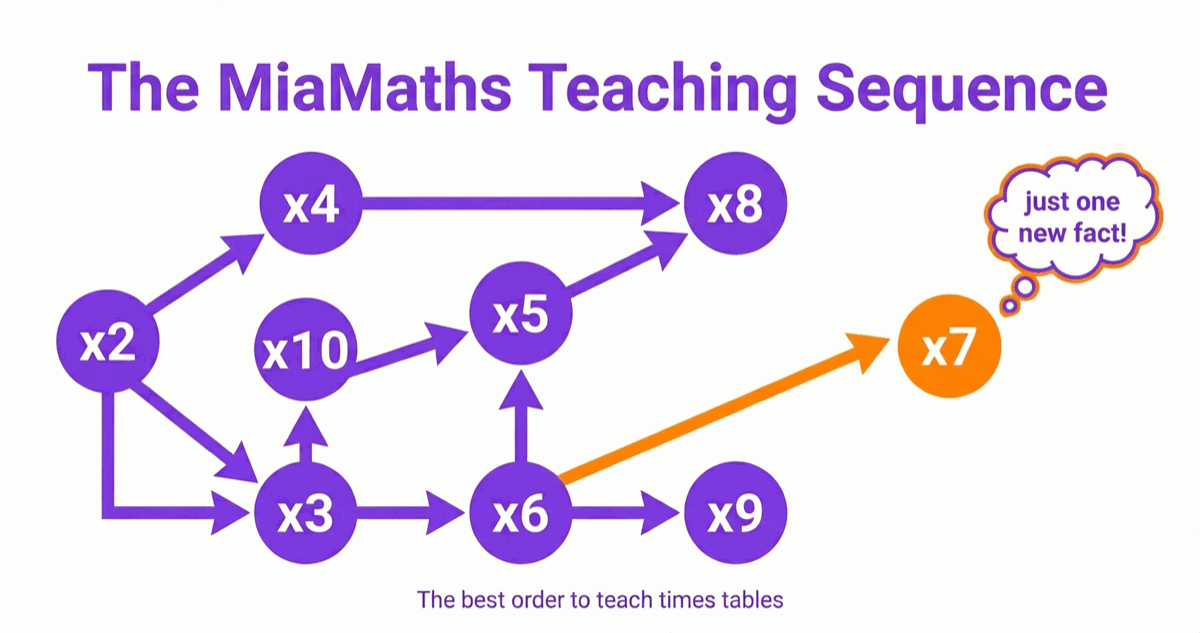
If you're helping your child learn their times tables, you've probably wondered where to start. Should you go in order — 1s, then 2s, then 3s? Or is there a better way?
There is. And it makes a bigger difference than you might expect.
The trick is to start with the easiest tables first, then use those as building blocks for the harder ones. Each new table becomes less work because your child already knows related facts.
Here's the order that works, and why.
Start with the 2s, 5s, and 10s
These three tables are the foundation. Most children find them straightforward because the patterns are so clear:
- 2 times table — doubles. Many kids already know these from addition. 3 + 3 = 6, so 3 x 2 = 6.
- 10 times table — just add a zero. 4 x 10 = 40. Children pick this up almost instantly.
- 5 times table — every answer ends in 5 or 0. The rhythm of 5, 10, 15, 20 is easy to remember.
In the UK national curriculum, these are the tables children learn in Year 2 (ages 6-7). There's a reason they come first — they give your child quick wins and build confidence before the harder tables arrive.
Tip: Don't rush past these. Make sure your child can recall 2s, 5s, and 10s without hesitation before moving on. A solid foundation here makes everything else easier.
Next: the 4s and 8s (doubling what they already know)
Once your child knows the 2 times table, the 4s become surprisingly simple: just double the 2s.
For example:
- 6 x 2 = 12, so 6 x 4 = 24 (double 12)
- 7 x 2 = 14, so 7 x 4 = 28 (double 14)
And the 8s? Double the 4s:
- 6 x 4 = 24, so 6 x 8 = 48 (double 24)
This "doubling chain" — 2s to 4s to 8s — is one of the most powerful strategies in times table learning. Your child isn't memorising from scratch each time. They're building on what they already know.
In the national curriculum, the 4s and 8s are part of Year 3 (ages 7-8).
Then the 3s
The 3 times table doesn't have the neat doubling shortcut, but it follows a useful pattern: odd, even, odd, even (3, 6, 9, 12, 15, 18...).
There's also a handy strategy: if your child knows the 2 times table, they can work out any 3s fact by adding one more group. For example:
- 5 x 2 = 10, so 5 x 3 = 10 + 5 = 15
- 7 x 2 = 14, so 7 x 3 = 14 + 7 = 21
The 3s are also taught in Year 3.
The 9s (easier than they look)
Many children dread the 9 times table, but it's actually one of the most pattern-rich:
The fingers trick: Hold up all 10 fingers. To multiply 9 by any number, fold down that finger. The fingers to the left are the tens, the fingers to the right are the units. For 9 x 4: fold down finger 4 — you'll see 3 fingers on the left and 6 on the right. Answer: 36.
The tens-minus-one strategy: 9 is just one less than 10. So 7 x 9 = 7 x 10 - 7 = 70 - 7 = 63.
The digit sum trick: The digits of every answer in the 9 times table add up to 9. Check: 9, 18 (1+8=9), 27 (2+7=9), 36, 45, 54, 63, 72, 81, 90. This gives your child a quick way to check their answers.
The 6s
If your child has learned the 3 times table, the 6s are just double the 3s:
- 7 x 3 = 21, so 7 x 6 = 42 (double 21)
By this point, something important has happened: your child already knows many of the 6 times table facts from the other tables they've learned. They know 6 x 2 from the 2s, 6 x 3 from the 3s, 6 x 4 from the 4s, 6 x 5 from the 5s. The commutative property (3 x 6 is the same as 6 x 3) means there are only a few new facts to actually learn.
Save the 7s for last
The 7 times table is widely considered the hardest. There's no clean doubling trick, no finger method, no obvious pattern.
But here's the good news: by the time your child reaches the 7s, they already know most of the facts. They know 7 x 2, 7 x 3, 7 x 4, 7 x 5, 7 x 6, 7 x 8, 7 x 9, and 7 x 10 from all the tables they've already learned.
The only truly new fact is 7 x 7 = 49.
That's it. One new fact. The rest is revision.
This is why the order matters. Teach the 7s first and your child faces a wall of unfamiliar facts. Teach them last and they barely notice.
The full sequence at a glance
| Order | Table | Strategy | UK Year |
|---|---|---|---|
| 1st | x2 | Doubles (from addition) | Year 2 |
| 2nd | x10 | Add a zero | Year 2 |
| 3rd | x5 | Ends in 5 or 0 | Year 2 |
| 4th | x4 | Double the 2s | Year 3 |
| 5th | x8 | Double the 4s | Year 3 |
| 6th | x3 | 2s plus one more group | Year 3 |
| 7th | x9 | 10s minus one group; finger trick | Year 3/4 |
| 8th | x6 | Double the 3s | Year 4 |
| 9th | x7 | Most facts already known | Year 4 |
Why this order works: it's about connections, not memorisation
Research supports this approach. A study on how children learn multiplication found that similar-sounding facts interfere with each other in memory. When too many similar facts are introduced at once (like 6 x 7 and 7 x 8), children get the answers wrong significantly more often.
"Elementary math in elementary school: the effect of interference on learning the multiplication table" — Cognitive Research: Principles and Implications, 2022
Teaching tables in a strategic order — with doubling relationships and building on known facts — reduces this interference. Each new table feels like a small step rather than a fresh start.
It also means your child needs to memorise far fewer facts than you'd think. The full times tables grid from 2 to 10 has 81 facts. But once you remove the commutative pairs (3 x 4 = 4 x 3), the 1s, and the tables with easy patterns (2s, 5s, 10s), the number of facts that actually require rote memorisation drops to around 15-20.
Tips for practising at home
Keep it short. Five to ten minutes of focused practice beats an hour of reluctant drilling. Little and often is the key.
Don't move on too quickly. Make sure each table is solid before introducing the next one. Shaky foundations cause problems later.
Mix old and new. When practising the 4s, throw in some 2s and 10s to keep those fresh. Interleaving like this strengthens long-term memory.
Make it a game. Timed challenges, dice games, or racing against a sibling can turn practice into something children actually want to do. That's exactly why we built MiaMaths — it turns times tables practice into a head-to-head multiplayer race, so children are competing and having fun rather than staring at flashcards.
Use the commutative property. Remind your child regularly that 3 x 7 is the same as 7 x 3. This effectively halves the number of facts they need to learn.
What about the Year 4 Multiplication Tables Check?
If your child is in a state school in England, they'll take the Multiplication Tables Check (MTC) in June of Year 4. It's an online test: 25 questions, 6 seconds per question, covering tables from 2 x 2 up to 12 x 12.
The test is weighted towards the harder tables — 6s, 7s, 8s, 9s, and 12s appear more often. So following the order above and ensuring your child is confident with the trickier tables is the best preparation.
The results aren't published or used for school league tables. The check exists to identify children who need extra support — so there's no need to create anxiety around it.
Start where your child is
Every child is different. Some will fly through the 2s and 5s in a week. Others might need a month. That's fine. The goal isn't speed — it's fluency. You want your child to recall facts automatically, without counting on their fingers, so they can focus on more complex maths later.
Start with the 2s, build up through the doubling chain, and leave the 7s for last. By the time they get there, they'll realise they already know almost everything.
And if you want a fun way to put all that practice to the test, challenge them to a game on MiaMaths. Nothing motivates a child like trying to beat a parent.